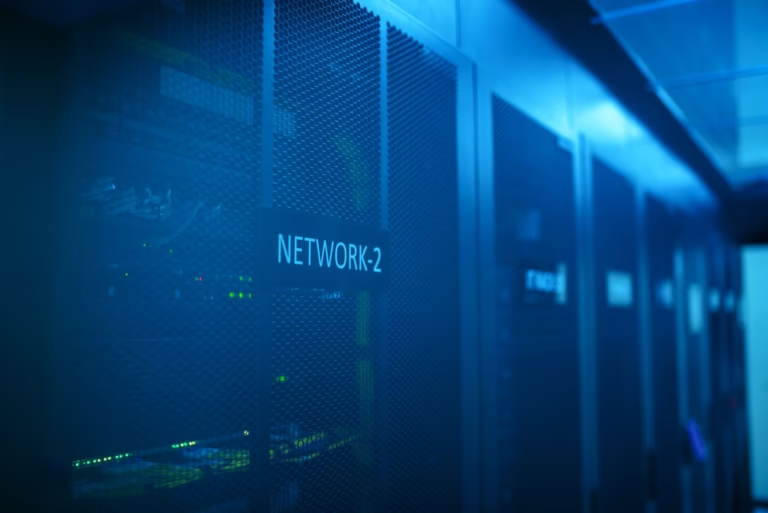
The AI party is still going strong. New infrastructure projects are propping up every single day, new users are multiplying by the second and everyone insists they are having the time of their lives. But somewhere along the way, a few people are starting to ask the least festive question in finance: “Who is paying all of this?”
AI investment is enormous and no one can deny otherwise. Be that as it may, the optimism remains sky high and nobody has rung the fire alarm, but that was old news. Concerns have moved well beyond online cynics as Federal Reserve officials are now discussing whether the speed of AI investment could create financial stability risks while others say an AI bubble is not present in the room with us.
Before we go deeper, an AI bubble is not simply technology that people do not like or stocks that went up a lot. It is what happens when expectations, prices and spending far outpace what can reasonably be earned. The technology does absolutely have real promise, the demand is clearly there considering organizational adoption has reached 88% and four out of five university students use generative AI, and the spending is expected to exceed an eye-watering USD 1 trillion in 2026. However, all optimism and hype aside, the question remains on whether future profits will be large enough and come fast enough to justify today’s valuations and enormous data centre bills. Let us rewind to 2000, shall we? Dot-com companies did not fail because the internet was fake, but useful ideas and sensible valuations are not the same thing.
There is a paradox developing over at Wall Street where 82% of the surveyed respondents thought AI trades are the most crowded, yet half still say AI is not in a bubble. It also does not help when chipmaker shares, major Korean chipmakers in particular, are tumbling sharply amidst concerns that AI demand and investments may be unsustainable. It is a perplexing stance really, as investors are not sure it is a bubble but on the other hand, remarkably sure everyone else is standing in it.
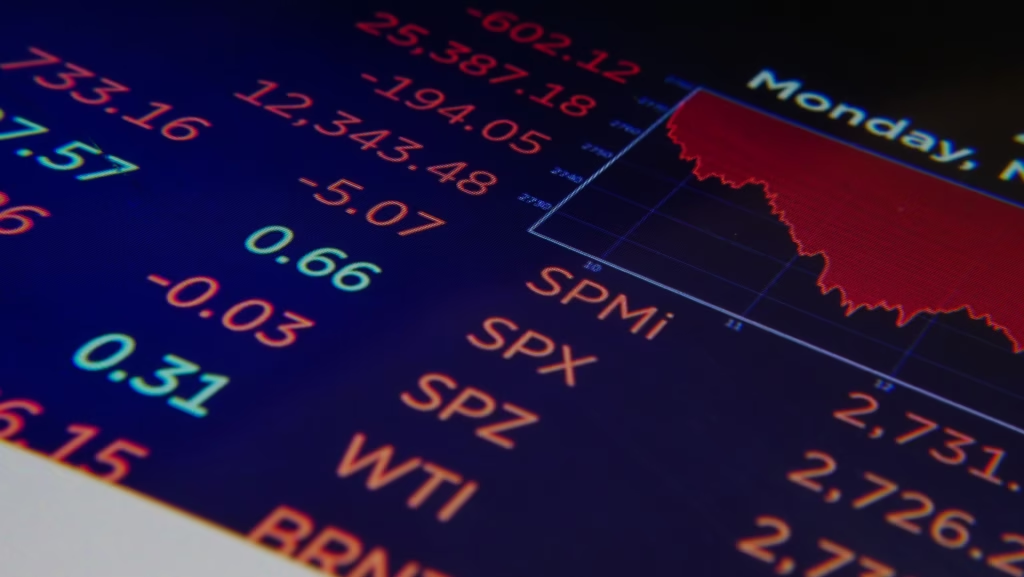
The growing worry is understandable. AI is not an app that can be built from a café with dodgy Wi-Fi and three iced lattes. The largest players are spending heavily on chips, servers, data centres and energy just to build the physical infrastructure required. A key question remains whether companies can charge users enough or save enough in costs to justify the scale of infrastructure spending we are currently seeing. AI products are popular, but popularity is not automatically a business model. Investors are also fickle when even a small disappointment can trigger a major sell-off. That does not mean the AI theme is dead in the water, but as time goes on, investors’ patience is growing thinner. The market is constantly swinging between two extreme beliefs: AI will make every company more productive, or it will be a very expensive waste of time.
However, investment firms are leveraging AI as assistive tools rather than fully autonomous systems as they move from experiments to implementations. The biggest technology companies of today also have profits, cash flows and established user bases unlike many speculative companies during the dot-com era. As such, the more realistic outcome may not be an AI apocalypse, it could simple be a long-overdue round of corporate budgeting. The best-case scenario is that AI can eventually turn today’s infrastructure bills into lower operating costs, new software revenue and productivity gains, but ‘eventually’ is doing a lot of heavy lifting here.
At this point, the question is no longer whether AI will change the economy (it most probably will), but whether every company currently brandishing an AI badge deserves to be priced as if it already has. The AI party may continue for years to come, but the market has noticed that the infrastructure, the electricity and the financing needed to tie the whole system together are all very expensive.
About the Author